Complaint system for Karnataka's universities

Raise a complaint once, in Kannada or English. A named officer routes it to the body its rules name, and Maadhyam tracks each clock until the decision is carried out.

Runs the UGC Equity Regulations, 2012, the UGC Grievance Regulations, 2023 and the POSH Act, 2013.

One register for every complaint

Each matter carries its reference, the body deciding it and the days left. Open one to see its hearing, its decision and every direction until proof arrives.

See how a matter moves

From complaint to proof in four steps

  1. Raise a complaint anywhere

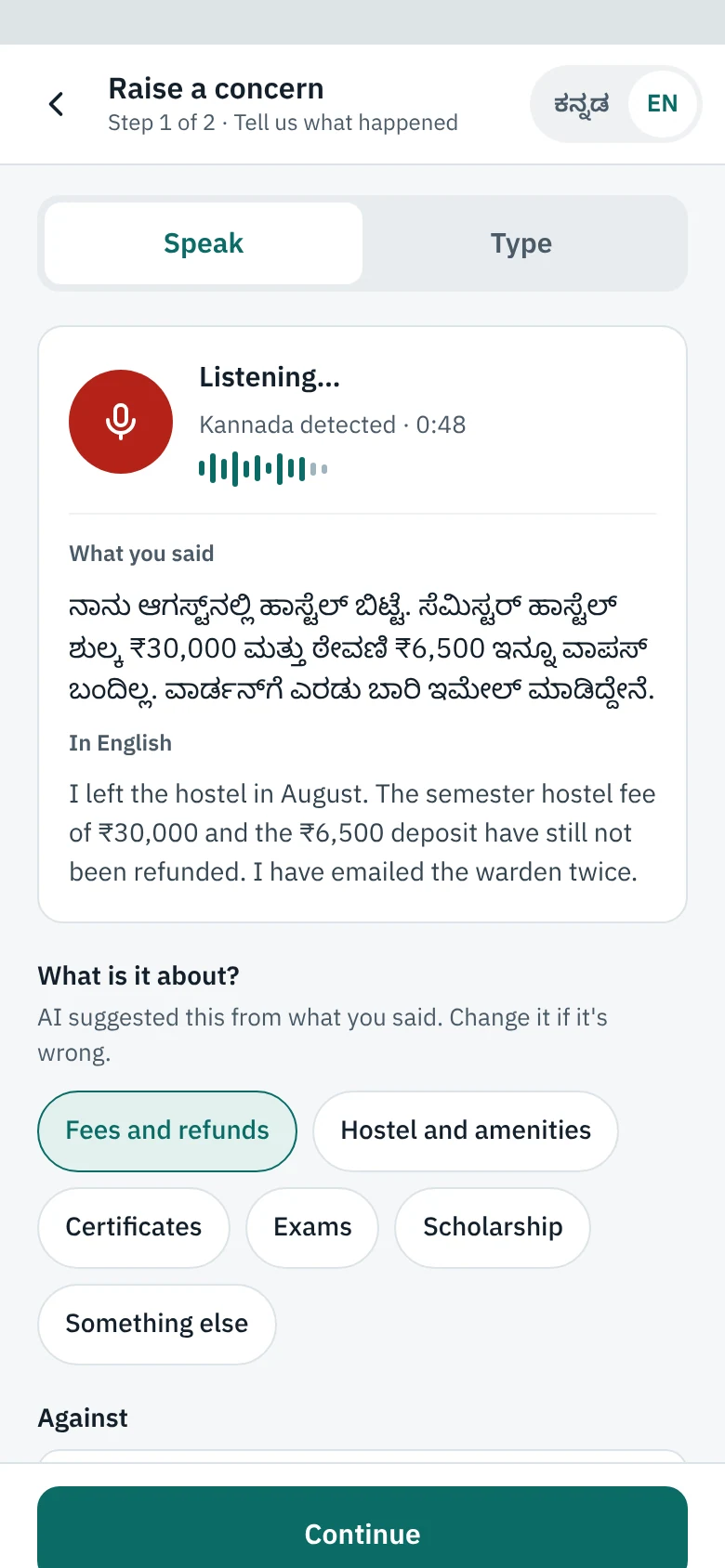
    The app, WhatsApp, SMS, a college help desk or a paper letter, typed or spoken in Kannada. A reference comes back at once.

    The student app: a Kannada voice note transcribed, with the English version under it and a suggested category of fees and refunds
  2. An officer confirms the complaint's route

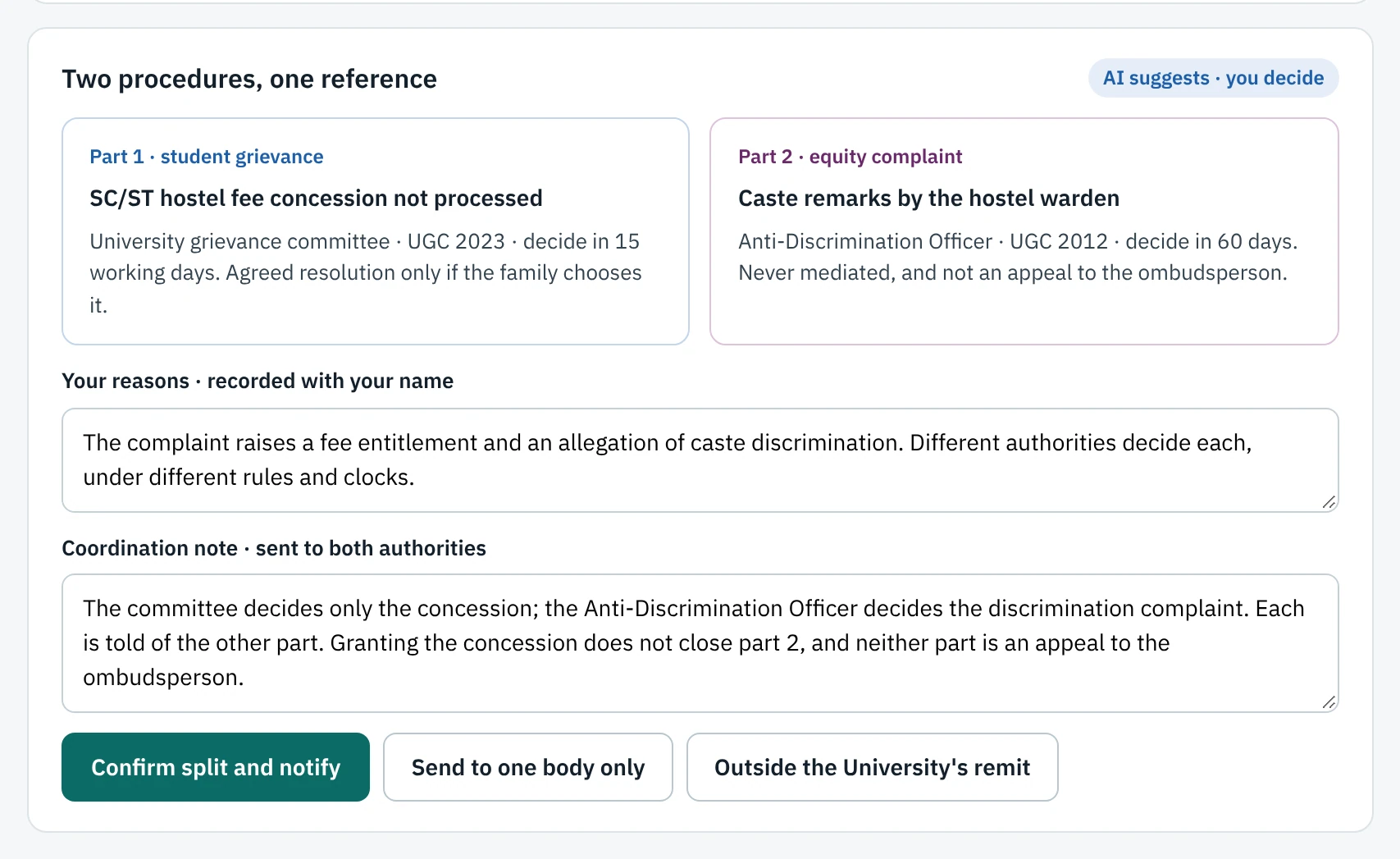
    A person checks jurisdiction and urgency and records why. AI may suggest a route; it never rejects a complaint.

    Routing review: one complaint split into two procedures under one reference, with the officer's reasons and a coordination note
  3. The right authority decides the complaint

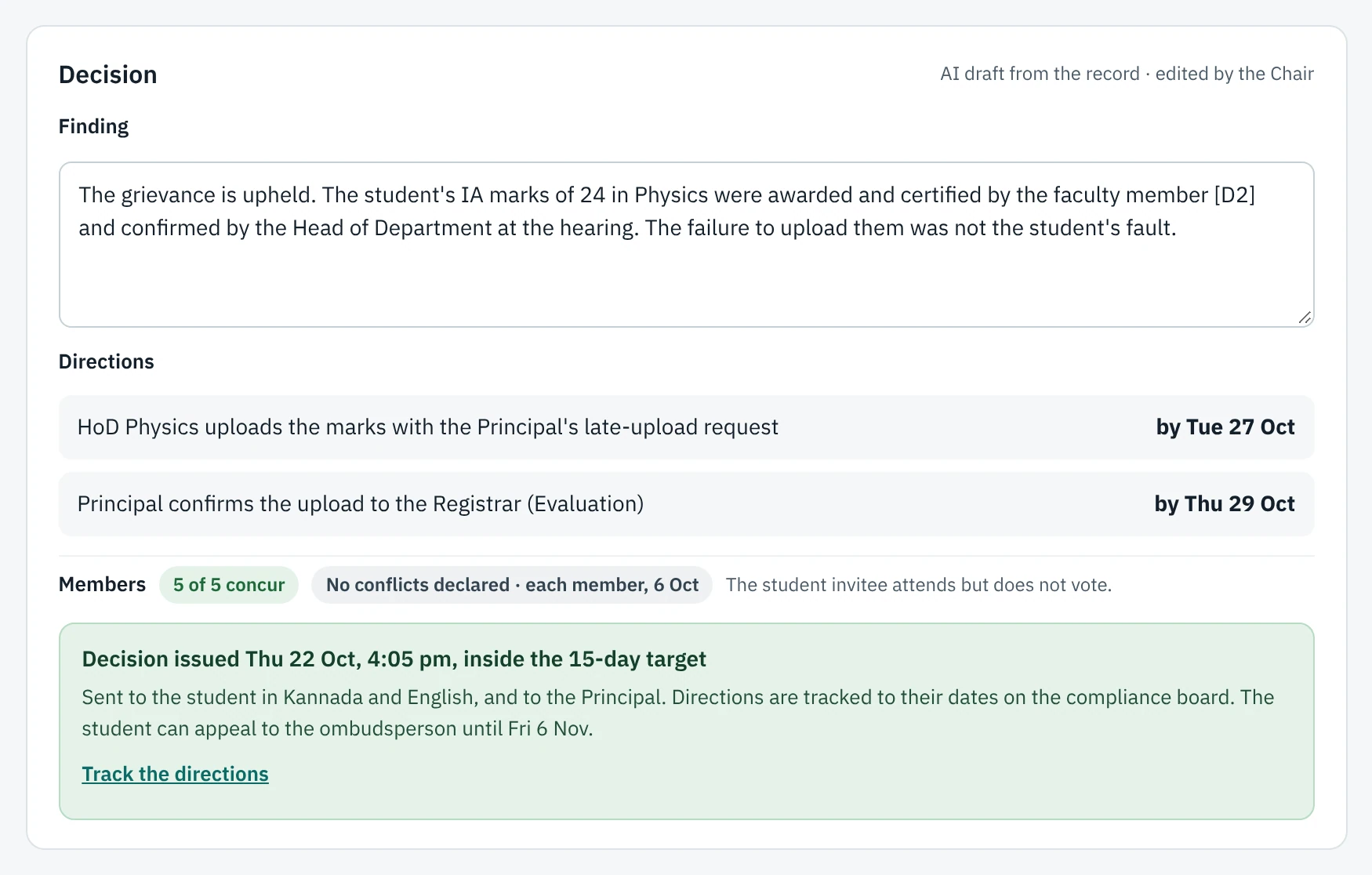
    A committee, the Anti-Discrimination Officer or the Internal Committee hears both sides and decides on its own clock.

    A committee decision: the grievance upheld, two directions with their dates, and every member's conflict declaration
  4. Directions followed until the complaint closes

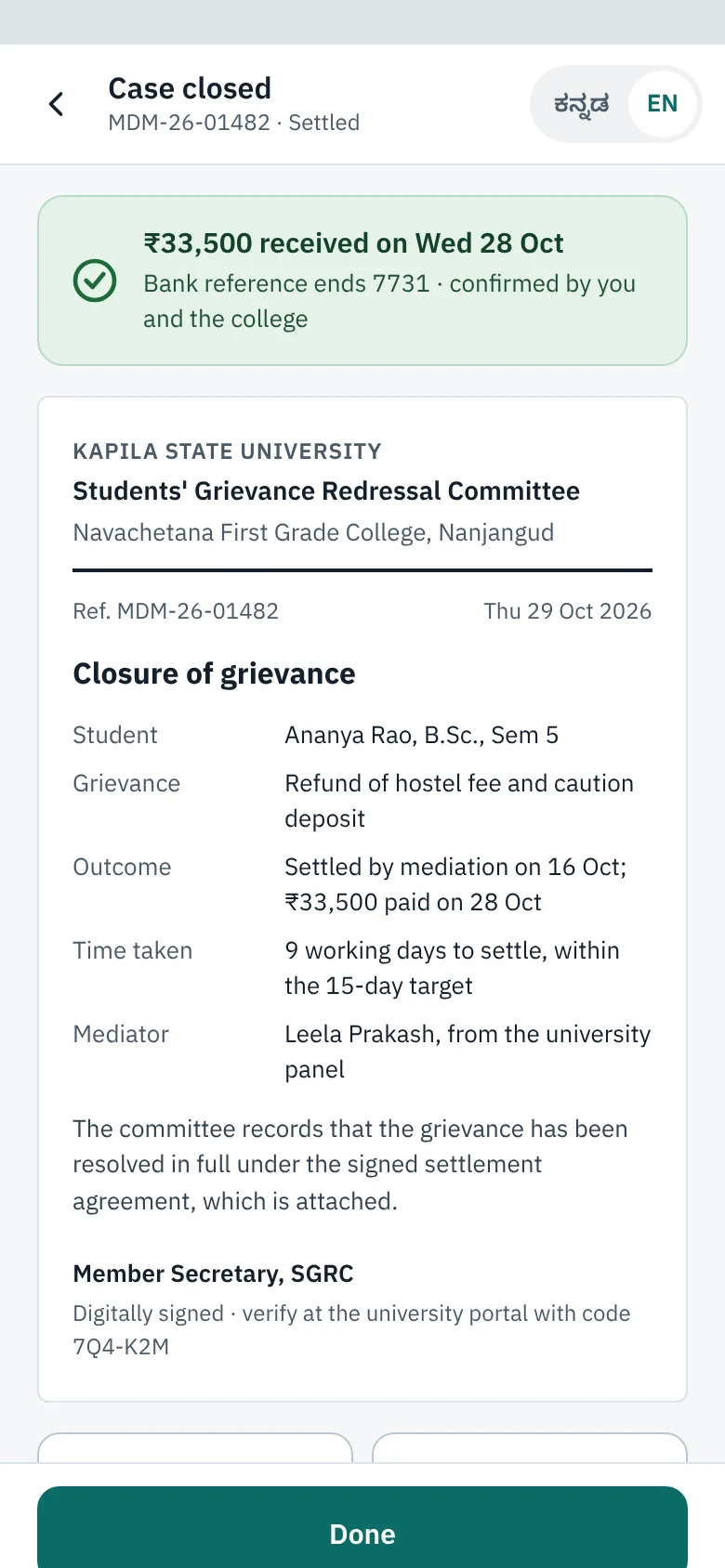
    Each direction goes to the office responsible. Missed dates escalate, and a file closes only when proof is in.

    The student app: a refund of 33,500 rupees confirmed by the student and the college, and the signed closure letter

One route for each kind of complaint

The University approves each procedure before it is switched on, and no body gets powers its own rules do not give it. The stayed 2026 equity regulations stay off.

One referenceApp · WhatsApp · SMS · help desk · letter
  1. EQEquity complaintAnti-Discrimination OfficerUGC Equity Regulations, 2012within 60 days
  2. GRStudent grievanceGrievance committeeUGC Grievance Regulations, 2023aims for 15 working days
  3. OMAppeal on a grievanceOmbudspersonUGC Grievance Regulations, 2023aims for 30 days
  4. ICSexual harassment · sealedInternal CommitteePOSH Act, 2013 and UGC, 2015inquiry within 90 days
  5. ARRagging · sealedAnti-Ragging CommitteeUGC Anti-Ragging Regulations, 2009FIR decision within 24 hours
  6. AGAgreed resolution, by consentBoth sides, with a facilitatorThe University's approved procedure15 working days, extendable once

People decide. Maadhyam keeps the record.

AI transcribes, translates, summarises with page citations and drafts. It never decides, rejects, signs or sends, never learns from University data, and every use is logged on the case.

Complaints by voice, WhatsApp or letter

Every screen, notice and letter is in Kannada and English. Spoken complaints are transcribed for the student to check, and a help desk in each college files walk-ins and handwritten letters.

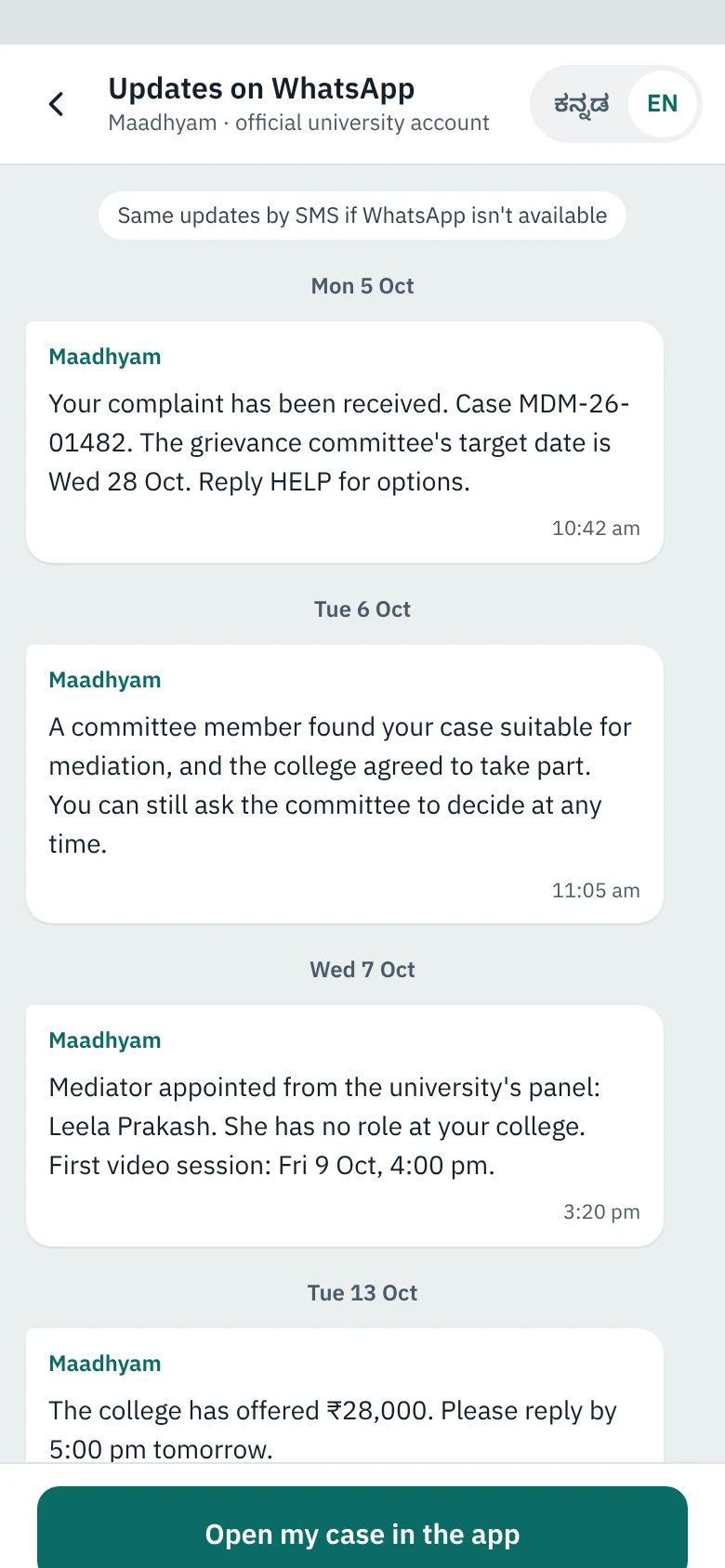
  • Updates on WhatsApp and SMS, with no app to install
  • A parent confirms for students under 18; harassment reports never wait
  • WCAG 2.1 AA, following the GIGW guidelines

Questions from Registrars

Something else? Write it in the demonstration request and we answer it on the day.

Go to the request form

Does Maadhyam decide complaints?

No. The body its rules name decides, such as a committee or the Anti-Discrimination Officer, and a named person signs every decision.

Does Maadhyam replace our cells and committees?

No. They work in one place, each with the rules, members and clock your statutes give it.

What about the UGC Equity Regulations, 2026?

The Supreme Court placed them in abeyance on 29 January 2026, so Maadhyam runs the 2012 regulations and keeps the 2026 rules switched off.

How would the University buy Maadhyam?

Through its own tender, with setup, support, hosting, AI, messaging and each extra college priced as separate lines.

How long until a Maadhyam pilot runs?

Three months: the legal position, then approval and setup, then training, tests and a controlled pilot. Existing channels stay open.

Security for sealed files and audits

Hosted in India, encrypted in transit and at rest, built to the DPDP Act and audited by a CERT-In empanelled auditor before go-live.

Seals every protected complaint

A Registrar sees that a protected case exists, its status and its clock, never its contents.

Access refused

MDM-26-01560 · part 2 is a protected case. Only the Anti-Discrimination Officer and the Equal Opportunity Cell can open it.

LoggedRegistrar · 4:22 pm

Escalates a missed direction

Reminders go to the college, then the Principal, then the Registrar, before a lapse reaches the UGC report.

3 working days beforeReminder to the college
On the due dateReminder to the Principal
3 working days lateEscalated to the Registrar
7 working days lateListed in the UGC report

Exports every complaint record

The University owns the data and can export all of it at any time, in standard formats.

CSVAll cases, 2026–27Ready
PDFAnnual grievance reportReady
PDFNAAC evidence packReady
JSONAudit trail with hashesReady

See Maadhyam run on your own cases

We run the seven cases a tender should ask every bidder to show, live, in Kannada and English.

  1. A discrimination complaint filed by a parentEQ
  2. A grievance, from filing to the closure letterGR
  3. One complaint that needs two proceduresGREQ
  4. A handwritten letter filed at a help deskGR
  5. An appeal to the ombudspersonOM
  6. A decision followed until proof arrivesGR
  7. A senior officer refused a sealed fileIC

A named person replies within 2 working days. We use these details only to arrange the demonstration.